Family Portrait
A Portrait of the Argentine family Partnoy which was captured by the dark shadows of the Argentine past.
In the center =>
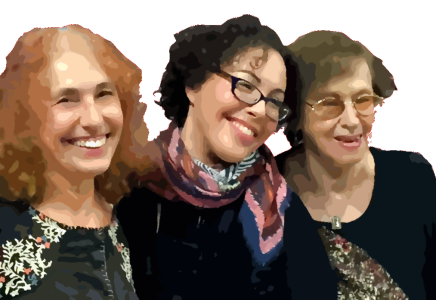
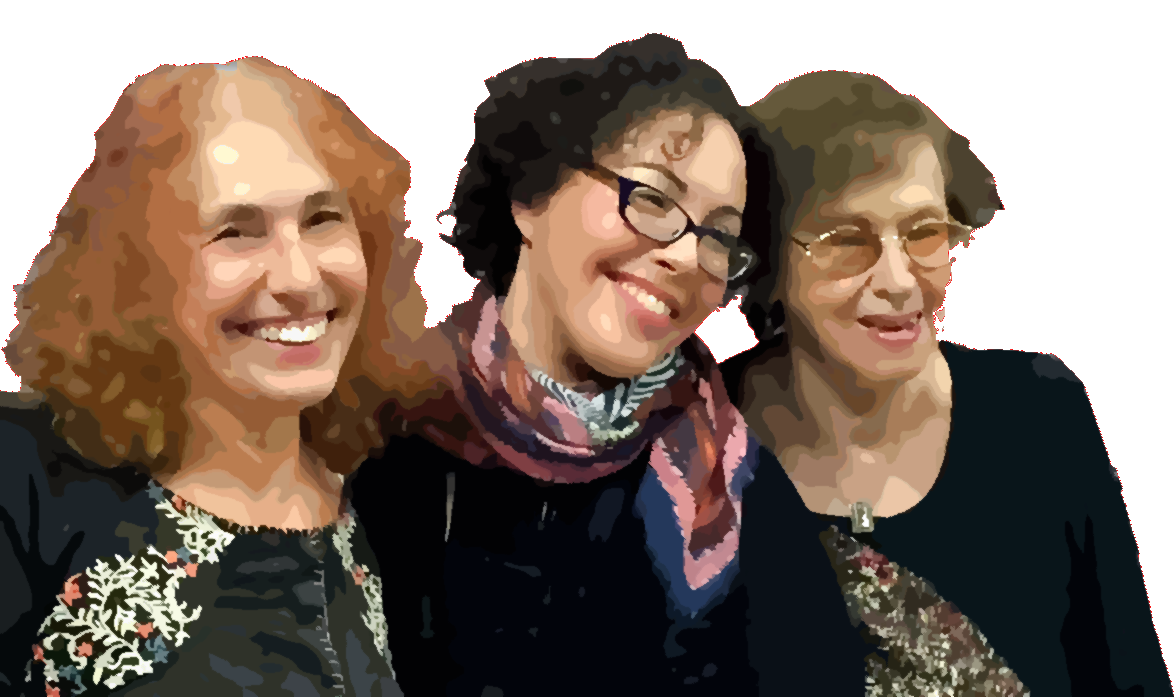
Mother, daughter and grand daughter of the Partnoy Family – who survived the so called Argentine Holocaust.
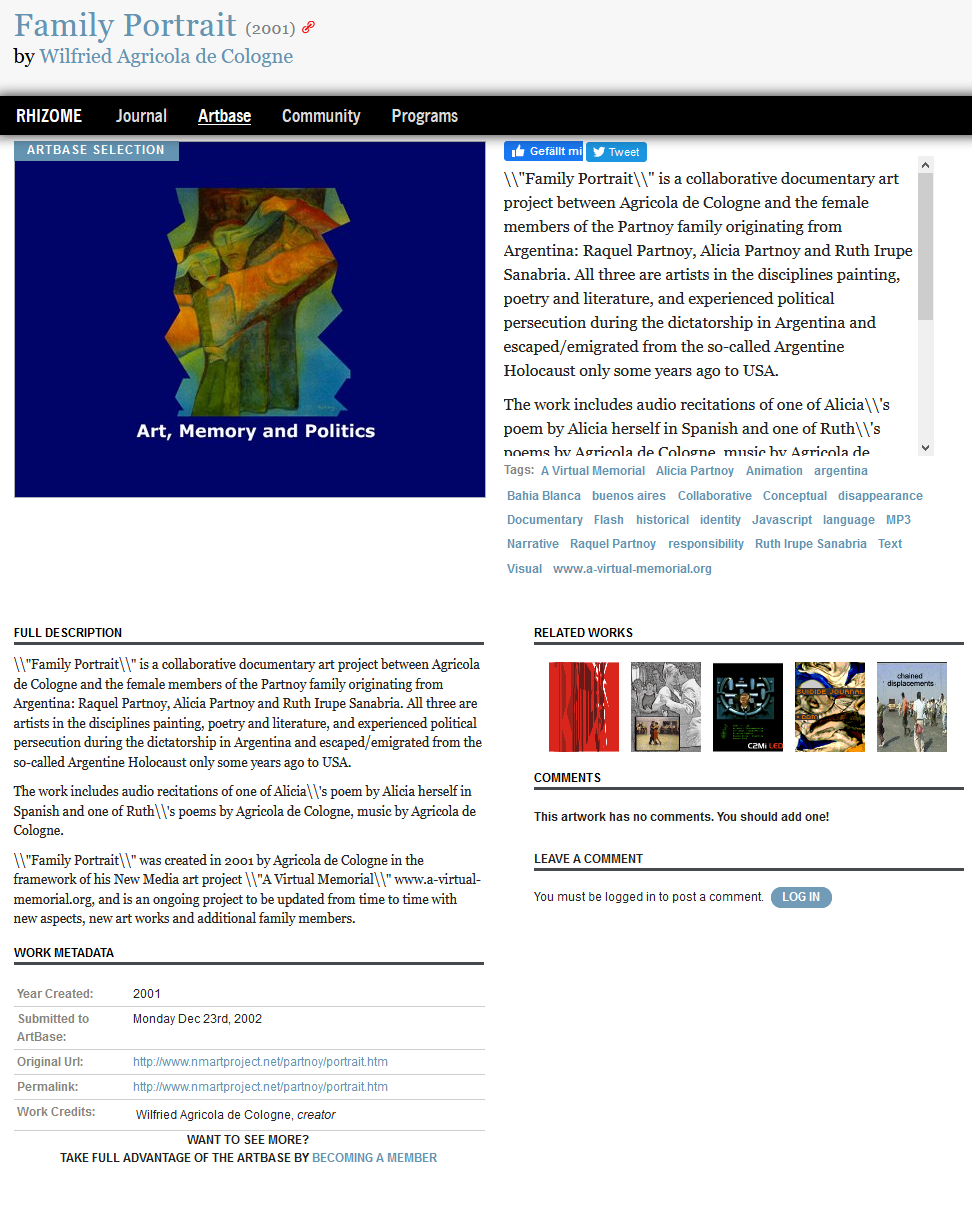
The project created 2003-2005. focussing on the historical background and the work of these three visual artists and poets is a collaborative work between the 3 family members and Agricola de Cologne.
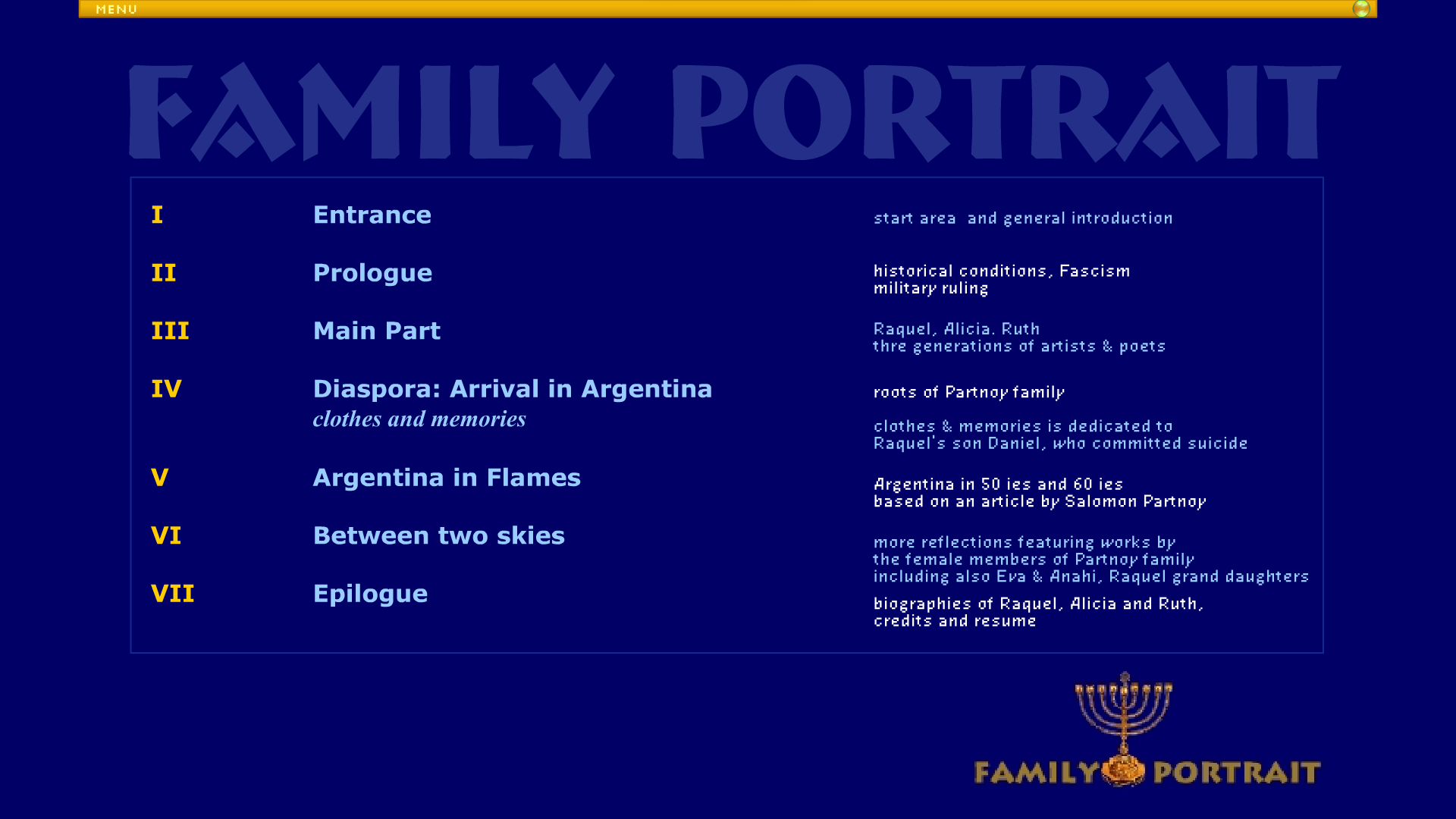
Agricola de Cologne’s collaborative project “Family Portrait” portrays three generations of the Partnoy family from Argentina in a triple diasporic tale of survival and artistic creativity. The Partnoys escaped persecution in Europe, fleeing to Argentina where they were once again persecuted during the so-called Argentine holocaust during the military dictatorships. After being “disappeared” and imprisoned in Argentina, Alicia (Raquel’s daughter) and her family found asylum in USA, where later in 1994 also Raquel and her husband Salomón emigrated to, and they all live now as visual artists, writers and poets.
In the framework of MOSAIC AWARD 2005, Agricola produced a third and final version of “Family Portrait” including new aspects of the story and a chapter about the lost son of the Partnoy Family. Agricola’s project spotlights poignant aspects of Jewish diasporadic history (Argentina) as well as artists whose identity and work is formed by this Jewish history.
Introduction
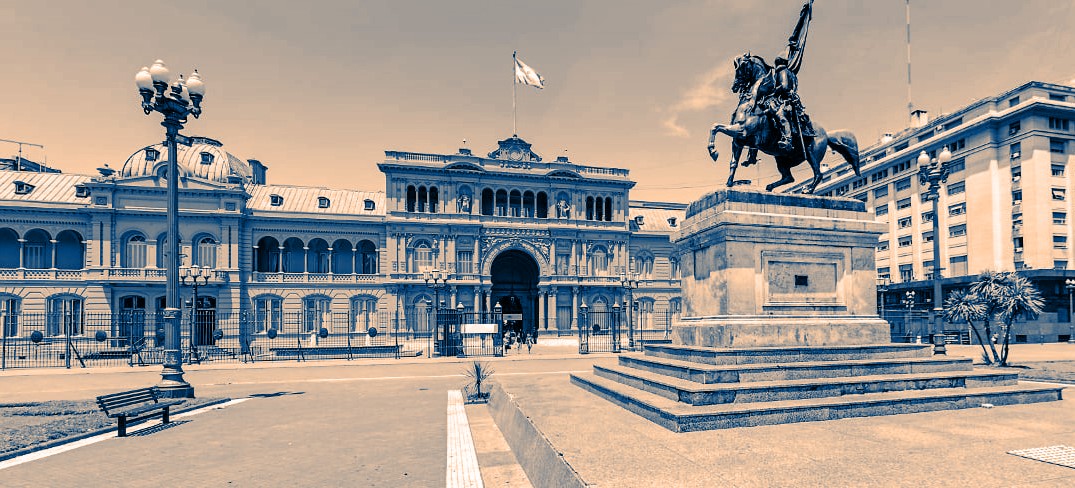
Visiting Argentina in October 2005 had a particular relevance, because it is a particular project Wilfried is presenting. In 2001, he met Raquel Partnoy virtually in Internet, one of the Mothers of Place de Mayo, like many of the them of Jewish origin. Her family was escaping from the economical disaster and progroms in Eastern Europe looking for a place to settle and live in peace, thinking finally Argentina was the promissed land, but the military rulers came in Argentina to power persecuting different minded like they are persecuted by most totalitarisn systems. The particular terror in Argentinia was the so called Argentine Holocaust – The Dirty War – the war of the military rulers against the own population – kindapping primarily the male members of a family like fathers and sons collecting them like the Nazis in detention (concentration) camps in order to kill ten thousands of them in most infamous ways.
When Wilfried heard about this background of Raquel as an artist, who had been participating in one of his previous projects, he invited her for collaborating intending to create an Internet based project about the diasporadic life of her family, entitled: Family Portrait. His fascination of this collaboration is manifested in this project, but it was just the start of a new project, because meanwhile Wilfried had several female artists from Argentina participating in his projects, – inspriing Wilfried to check whether they could imagine to work on a common project about the Mothers of Plaza de Mayo, by contributing material of different kind like art works, images, texts, interviews, testimonies etc.
Raquel was acting as a co-curator together with Wilfried, while Anahi Caceres involved her artists network arteUNA which was working (by chance) on a similiar topic. Like Raquel of Jewish origin, Anahi was of Mapuche origin, one of the indigeneous peoples living in Argentina and Chile and also particularly affected by the military persecutions during the Dirty War, together with Andamio Contiguo- a female artists couple from Santa Fe, and Marina Zerbarini and Irene Coremberg, Wilfried had soon the team for the common project, and then this project was complete consisting of a diversity of different components.
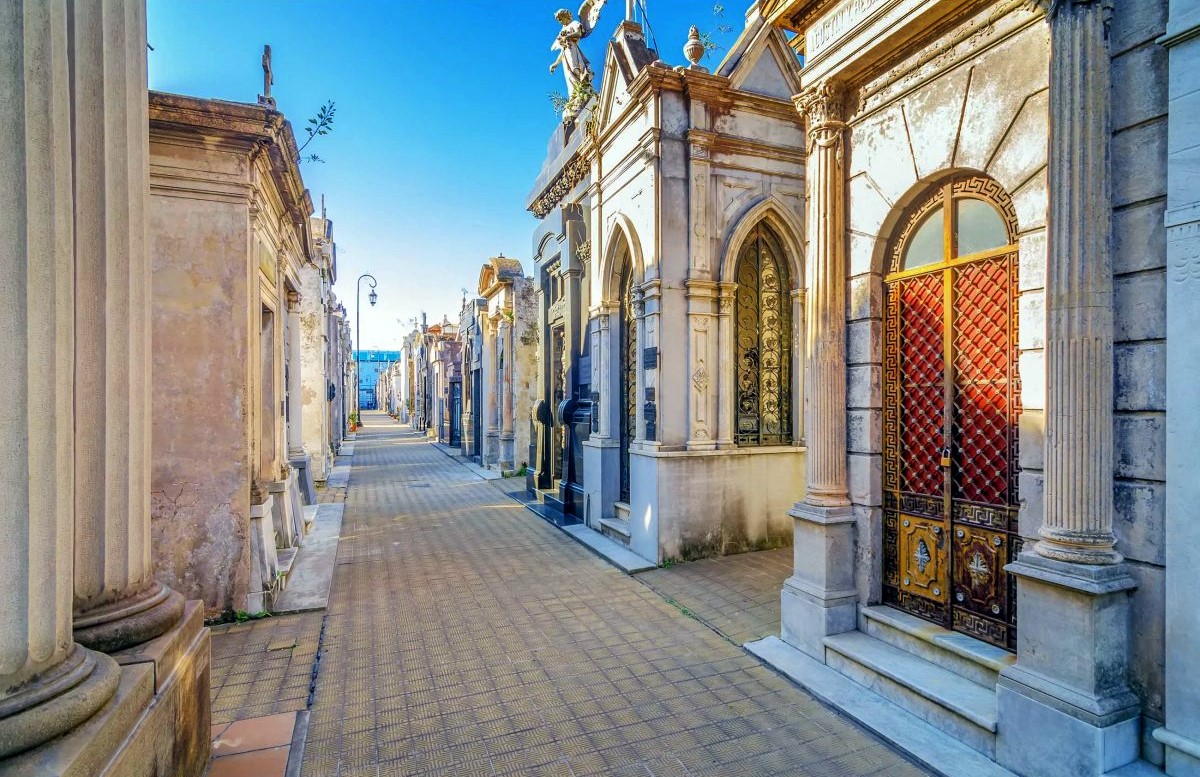 It was Anahi who had the idea to invite Wilfried to present their common project in Argentina – but how could such ideas be realized. In 2005, the constellation of Wilfried’s activities was very promissing, he was collaborating with several festivals and institutions in Latin America, for instance FILE – Electronic Language Festival, and when Wilfried’s ideas were taking shape to make a kind of tour through Latin America, he contacted the Goethe Institutes in Sao Paulo and Montevideo/Uruguay, and the result of the negotiations was, that these institutes accepted Wilfried’s budget plan to share the travel and accomodation expenses amoung different partners – Wilfried was coordinating the travel in Cologne and – then, the dream actually came true, Wilfried was holding the flight ticket in his hands and was waiting to leave Cologne for Madrid, where he had to change the plane for Sao Paulo, where he had to change a 2nd time for the next plane to Buenos Aires, a really long distance over night flight,
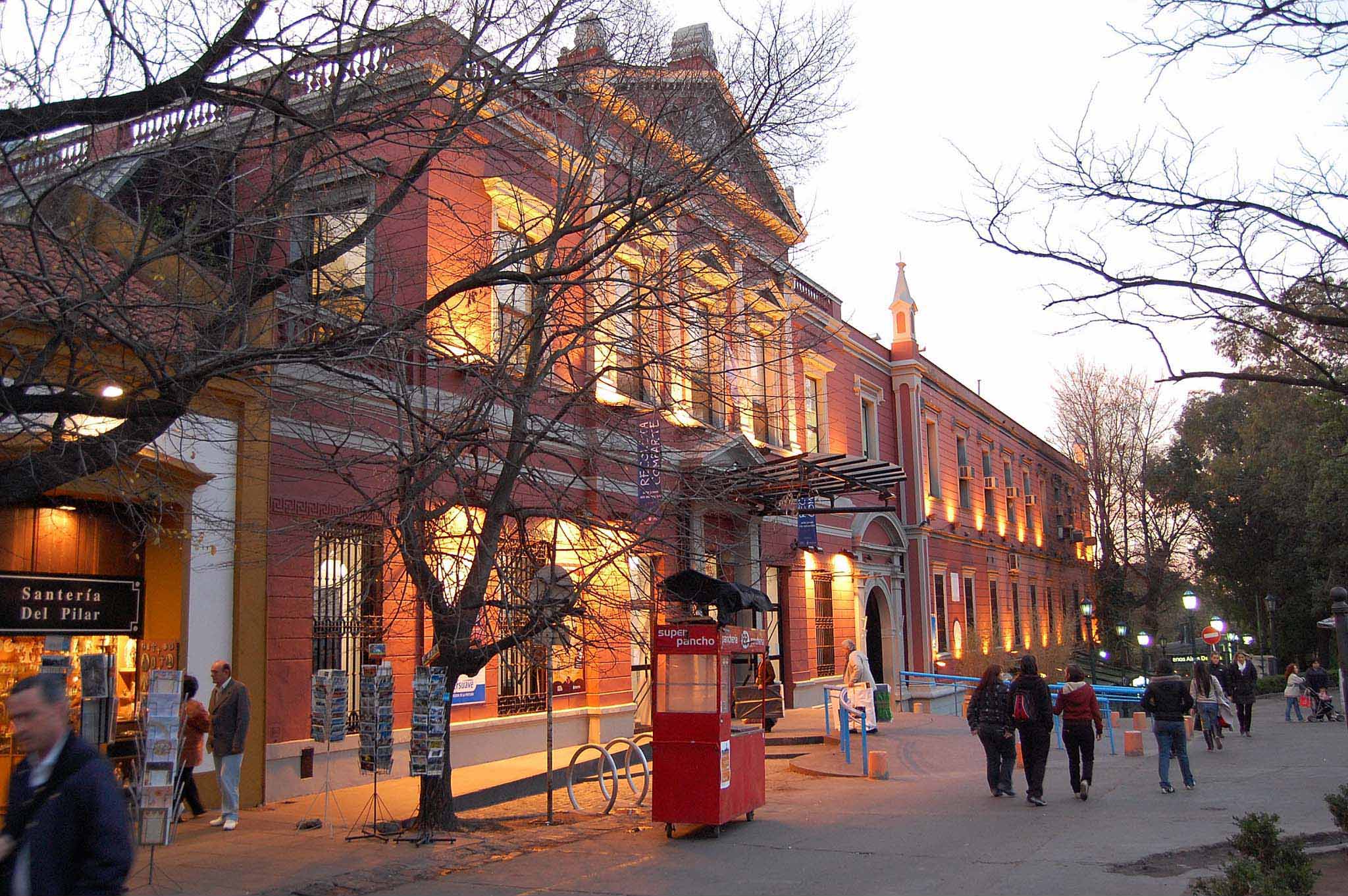 Anahi catched him in Buenos Aires at a bus stop, taking him to his hotel, and – this was really a surprise – in Buenos Aires the Recoleta Cultural Centre is running a hotel for artists on the ground of the cultural center. It was simply incredible to be part of a kind art installation, because this hotel is such a wonderful place, and the venue for the 1st project presentation is Recoleta, this evening, 11 October 2005, tomorrow, 12 October Anahi arranged a 2nd presentation at The National Bibliotheque, but this evening has a particular relevance, hardly to believe but Wilfried will meet not only the other participants in the project, besides Raquel who is residing in Washington DC in USA, but representatives of the Mother pof Plaza de Mayo organisation will be attending, and these will be the most touching moments of the entire journey.
Anahi had made a wonderful organisation, she spent a lot of time with him, he met her arteUNA friends, so he saw some parts of Buenos Aires he usually would not see, the harbour area of La Boca, Retiro, the famous railway station and visited her home which is also her studio. In this end the time will be much too short to stay and to tell about.
Wilfried Agricola de Cologne’s statement
Although I never met any member of Partnoy family personally, due to the most intensive and trustful contatcs to Raquel since 2001, it is just like I am a close friend to the family and I would know all of them since long time. When I came in touch with Raquel, I felt immediately touched by her visual and literary art work. It took not long time until the idea of the “Family Portrait” was born, but nobody would have ever expected a collaboration lasting for so many years. Especially Version III gives evidence how intimate the relation especially to Raquel had grown, as she opened an otherwise closed chapter of her life, her only son Daniel, who committed suicide. This trust makes me feel very proud!
The story behind may be seen as typical for Jews who tried to survive spead all over the world, but while being portrayed, these individuals leave the anonymous status and become real and very concrete, and a symbol for a nation in diaspora, not only in Argentina but any part on the globe.

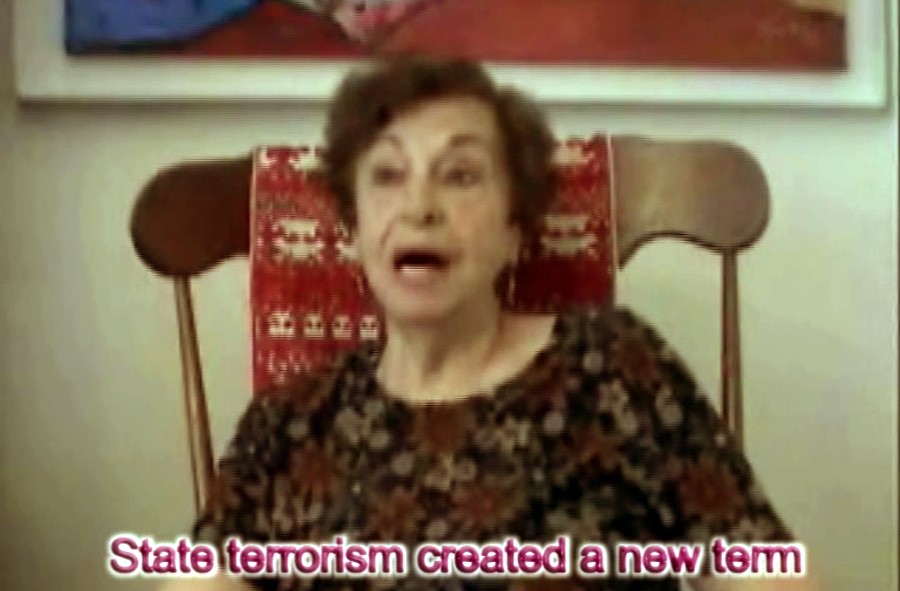
Raquel’s statement
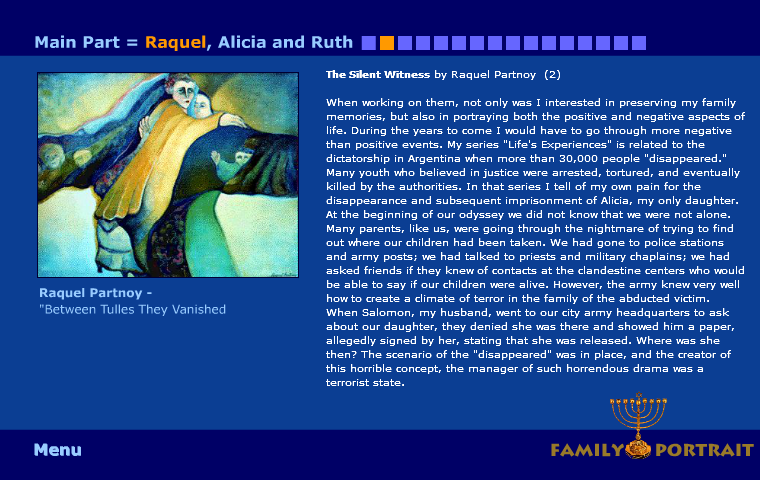
As a mother of a “disappeared” child I experienced the horror of seeing how my family was gradually destroyed. From the day my daughter and her husband were kidnaped by the military forces during the military dictatorship in Argentina – 1976/1983, life was not the same for my husband, my son, or myself . Anguish, hatred, and depression overwhelmed us while we wondered if they were still alive, felt impotence because the military wouldn’t give us any kind of information, spent endless nights without sleeping for fear that the evil ones would come to our house to take another family member.
At the beginning of our odyssey we did not know that we were not alone. Many parents,like us, were going through the nightmare of trying to find out where our children had been taken. We had gone to police stations and army posts; we had talked to priests and military chaplains; we had asked friends if they knew of contacts at the clandestine centers who would be able to say if our children were alive. But the army knew very well how to create a climate of terror in the family of the abducted victim. When we went to our city army headquarters to ask about our daughter, they denied she was there and showed him a paper, allegedly signed by her, stating that she was released. Where was she then? The scenario of the disappeared was in place, and the creator of this horrible concept, the manager of such horrendous drama was a terrorist state. At that time, many families felt miserable, with thousands of young couples disappeared along with their babies or little children. Most of them were murdered by the military forces.
The women whose works I have chosen for “Women: Memories of the Repression in Argentina” have endured the horror of that time. These mothers, daughters, sisters of disappeared people, or survivors of the dictatorship, express their feelings through poems, tales, letters, or testimonies. They express the pain of thousands of women from our country.
As individuals who survived genocide, writers, artists, sensitive human beings, we shall never forgive, we shall never forget. We have to raise our voices in order to alert humanity about what happened not only in Argentina and other Latin America’s countries but also in the rest of the world, for such atrocities never to happen again.Raquel Partnoy
Washington,
February 2004

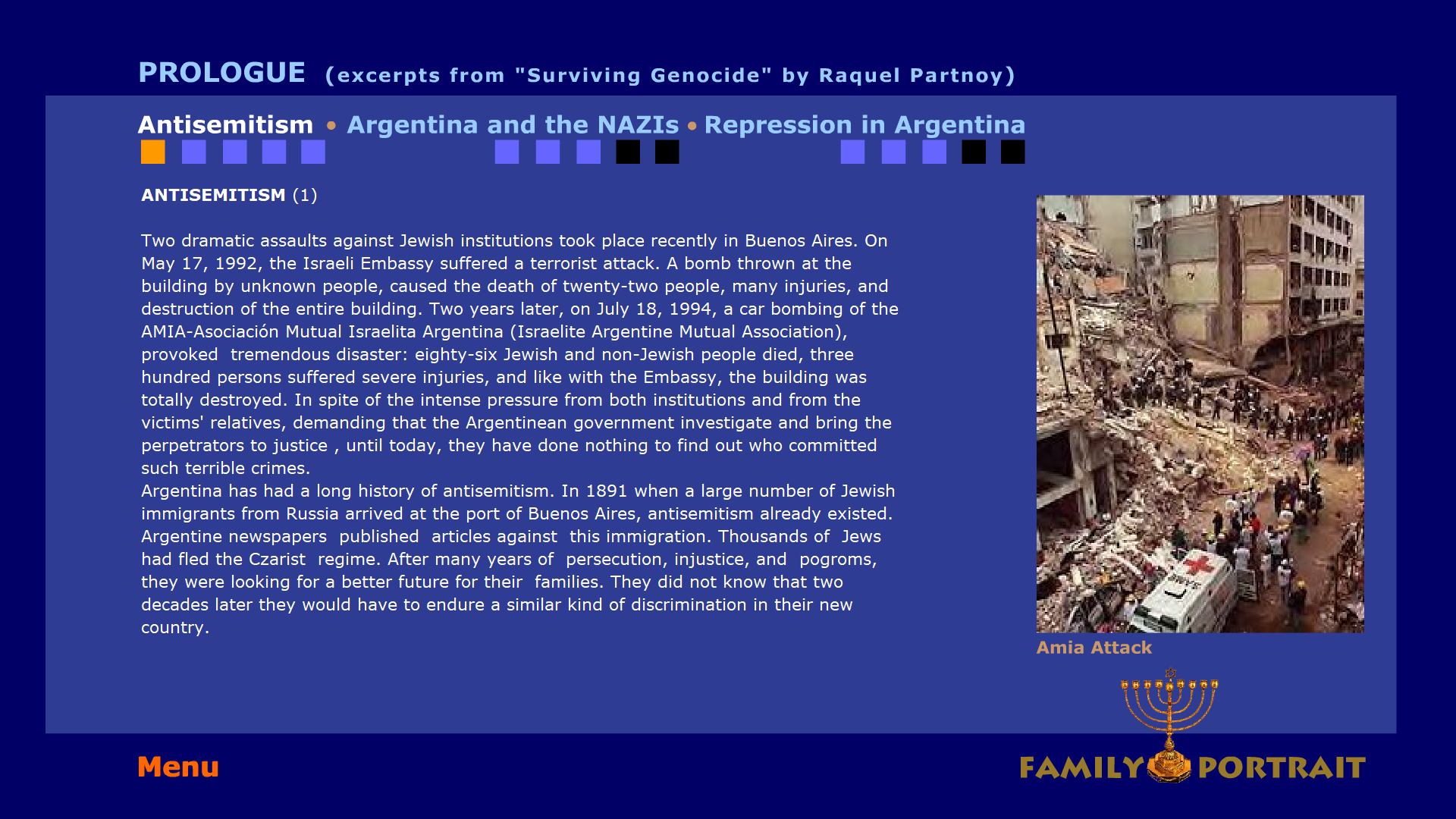


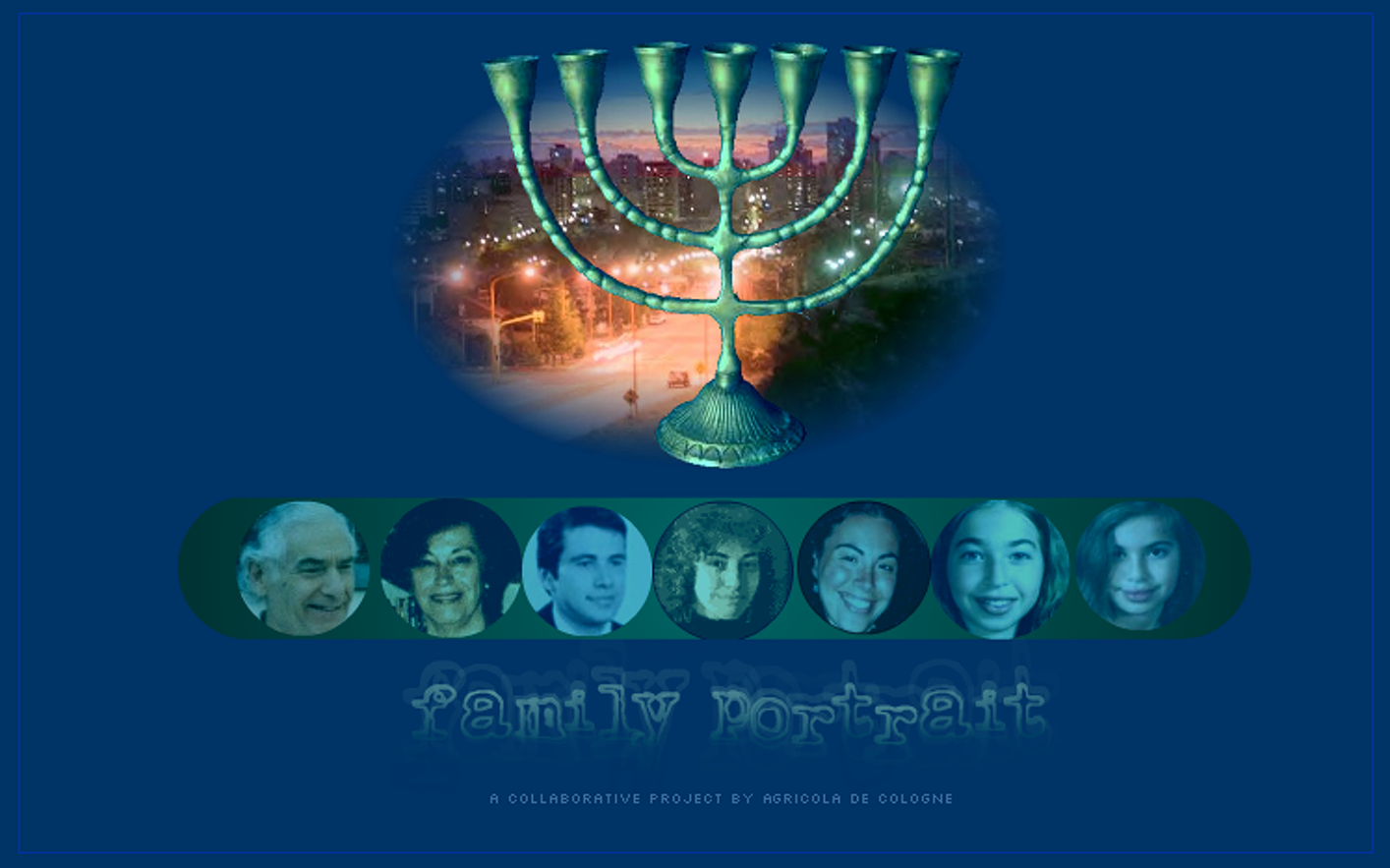
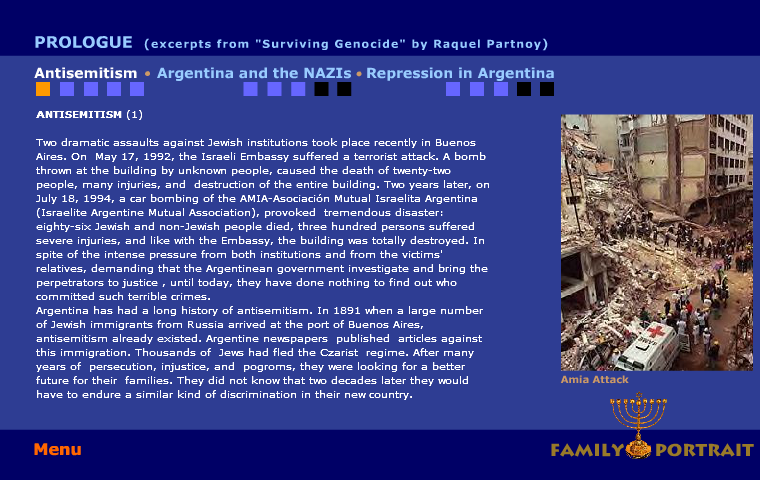
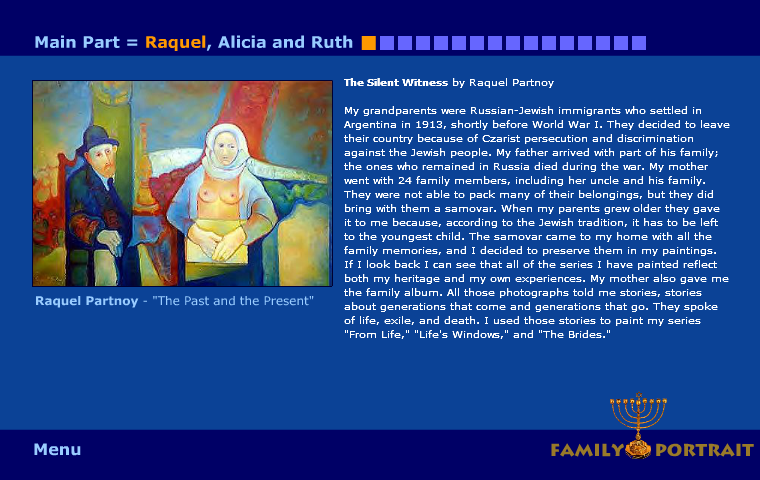
Buenos Aires, Junin, Rosario, Santa Fe
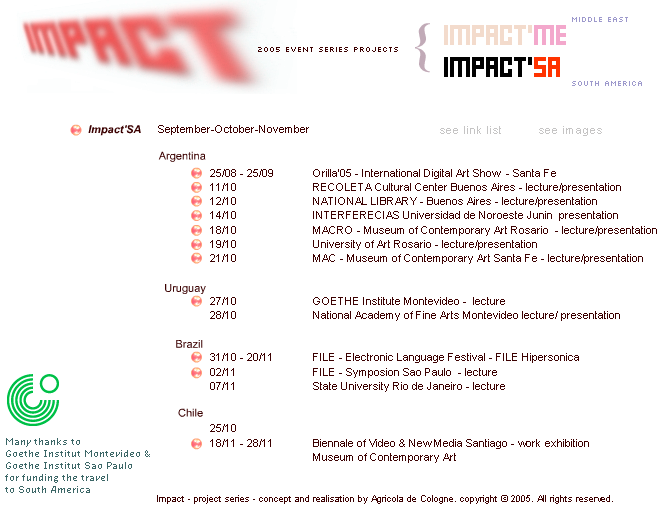
=>Buenos Aires
Centro Cultural Recoleta Buenis Aires – 11 October 2005
Bibliotheque Nacial Bues Aires – 12 October 2005
=>Buenos Aires – Junin
Universidad de Noroeste Interferencias Junin/Argentina lecture/presentation 13-16 October
=>Rosario
Macro – Museum of Contemporary Art Rosario – lecture/presentation 18 October
University of Art Rosario – lecture/presentation 19 October
=>Santa Fe
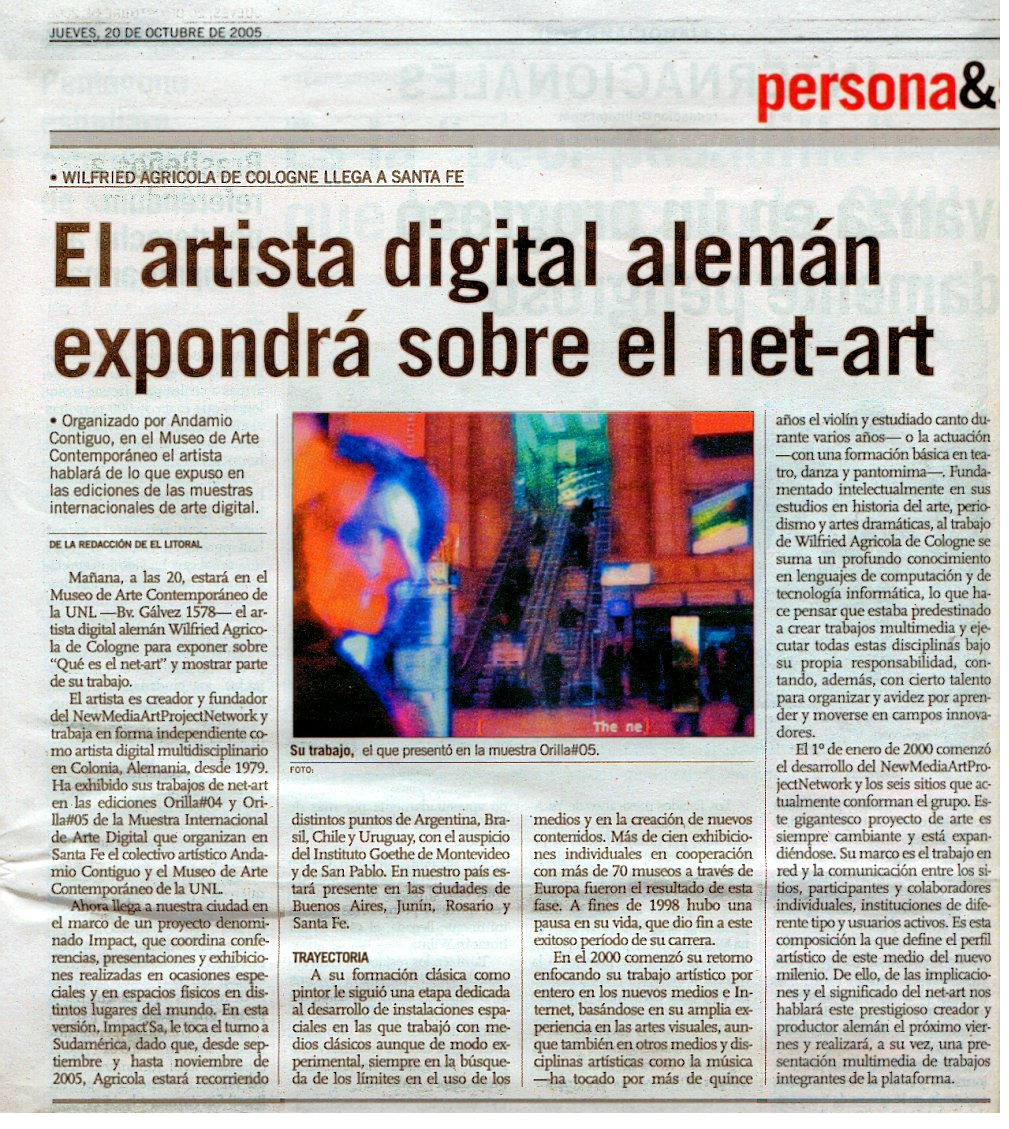
Museum of Contemporary Art Santa Fe – lecture/presentation 21 October
=>Santiago de Chile
Finis Terrae University Santiago/Chile – 25 October – lecture/presentation
7th Biennale of Video & New Media 18 – 28 November 2005 – Museum of Contemporary Art Santiago
=>Montevideo /Uruguay
Goethe Institute Montevideo/Uruguay – 27 October – lecture
National Academy of Fine Arts Montevideo/Uruguay – 28 October presentation Brazil
=>Sao Paulo
FILE – Symposion Sao Paulo – 1-4 November
=>Rio de Janeiro
Univercidade – IAV – Rio de Janeiro – 7 November – lecture/presentation
State University of Rio de Janeiro – 7 November – lecture/Presentation

Centro Cultural Recoleta

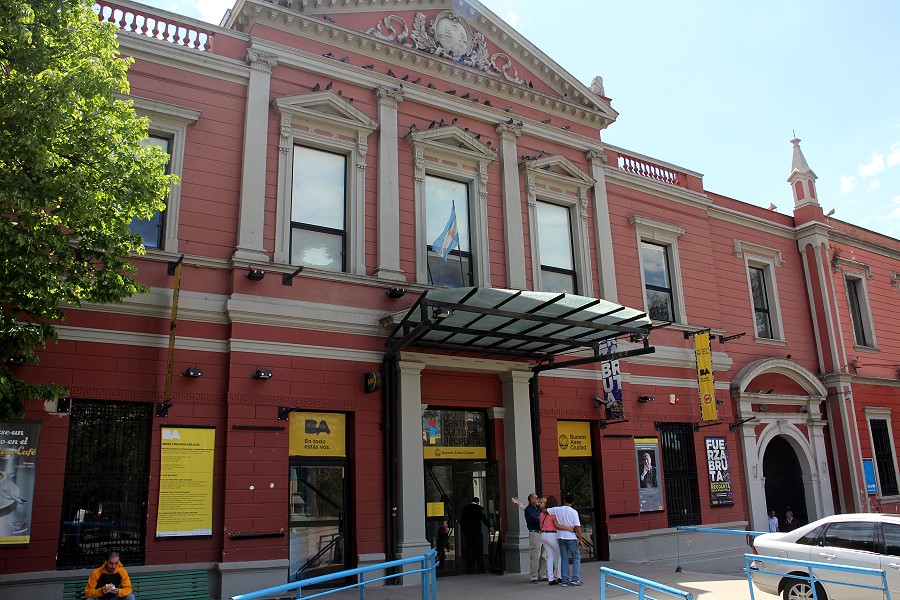
11 October 2005 – Centro Cultural Recoleta de Buenos Aires

12 October 2005 – Biblioteca Nacional de Buenos Aires
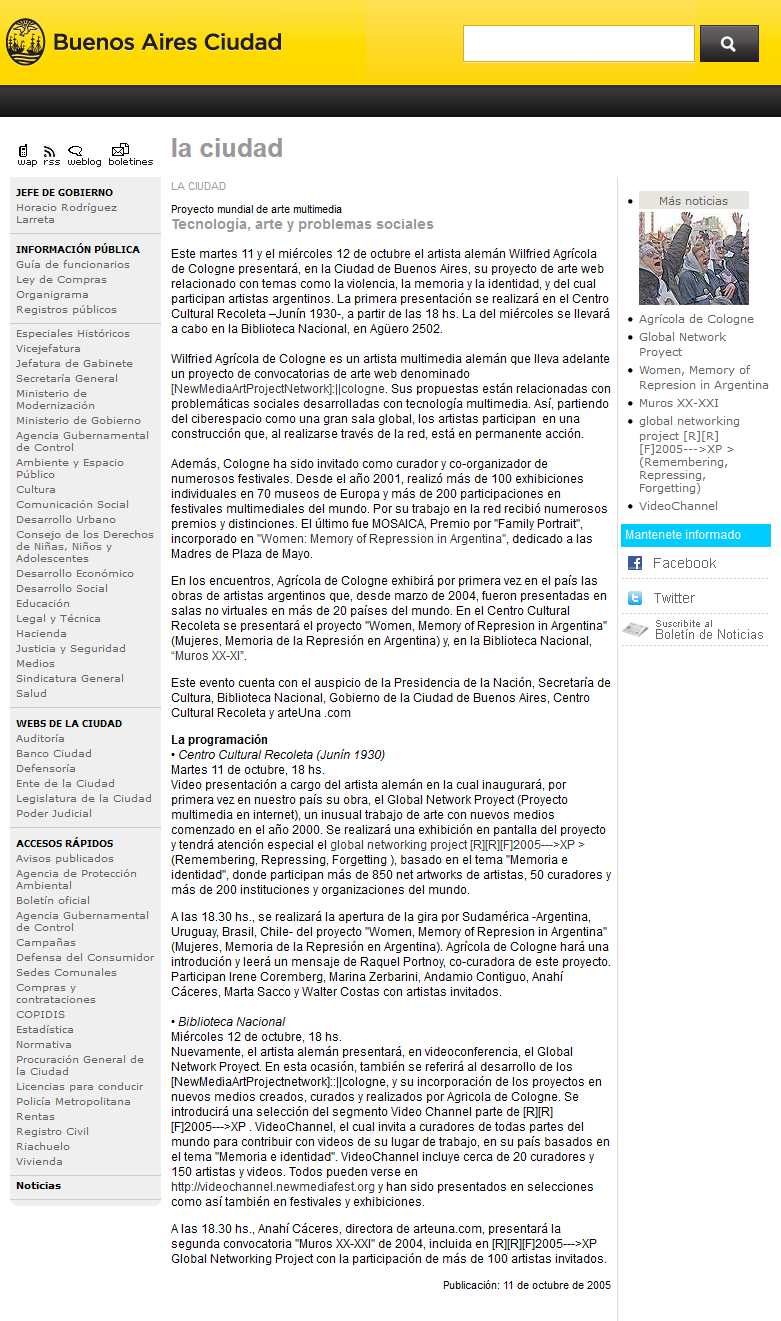
Press – 11 October 2005
Gobierno de la Ciudad de Buenos Aires
Agrícola de Cologne
Global Network Proyect
Women, Memory of Represion in Argentina
Muros XX-XXI
global networking project [R][R][F]2005—>XP > (Remembering, Repressing, Forgetting)
VideoChannel
Proyecto mundial de arte multimedia
Tecnología, arte y problemas sociales
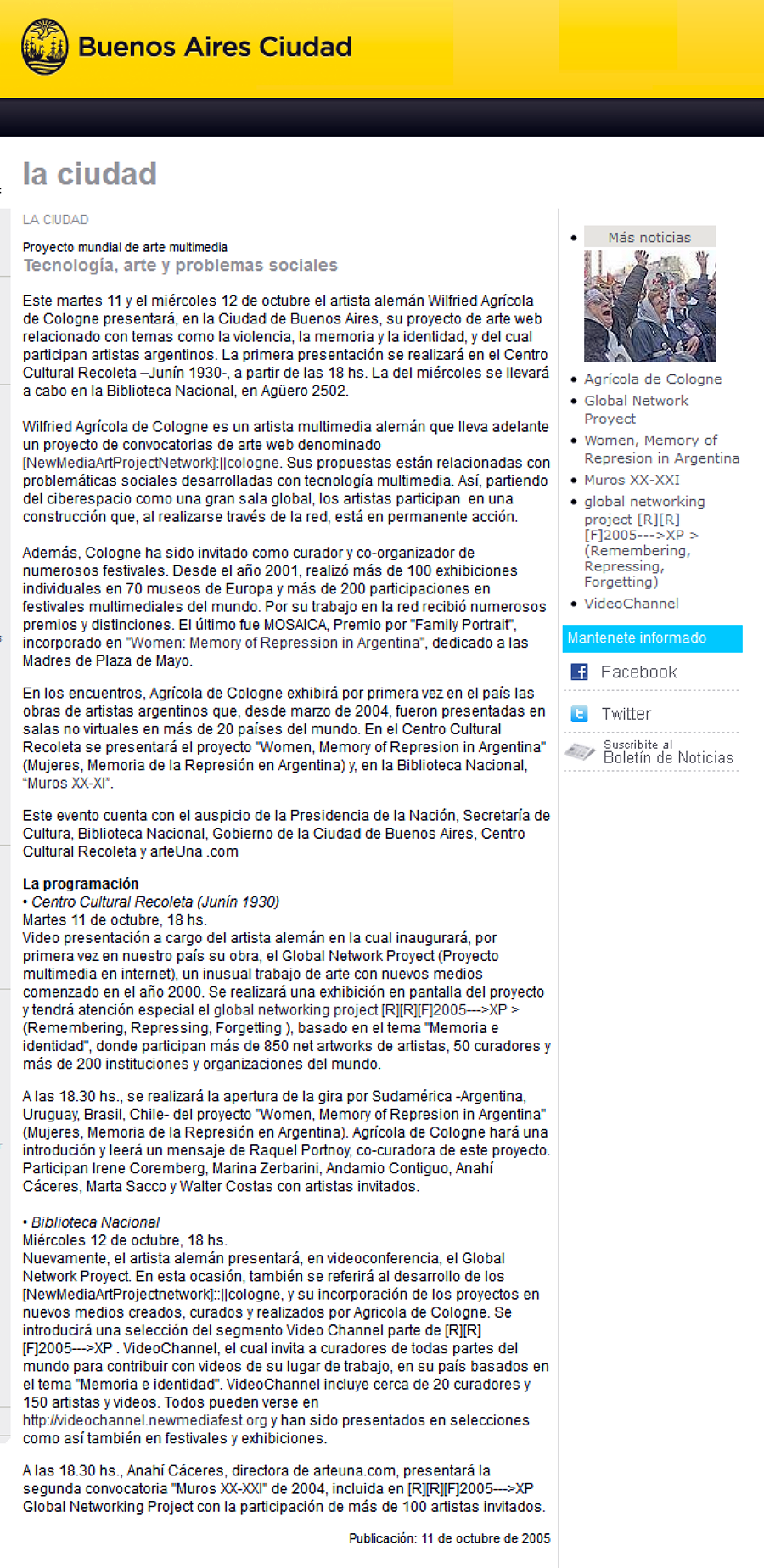
Este martes 11 y el miércoles 12 de octubre el artista alemán Wilfried Agrícola de Cologne presentará, en la Ciudad de Buenos Aires, su proyecto de arte web relacionado con temas como la violencia, la memoria y la identidad, y del cual participan artistas argentinos. La primera presentación se realizará en el Centro Cultural Recoleta –Junín 1930-, a partir de las 18 hs. La del miércoles se llevará a cabo en la Biblioteca Nacional, en Agüero 2502.
Wilfried Agrícola de Cologne es un artista multimedia alemán que lleva adelante un proyecto de convocatorias de arte web denominado [NewMediaArtProjectNetwork]:||cologne. Sus propuestas están relacionadas con problemáticas sociales desarrolladas con tecnología multimedia. Así, partiendo del ciberespacio como una gran sala global, los artistas participan en una construcción que, al realizarse través de la red, está en permanente acción.
Además, Cologne ha sido invitado como curador y co-organizador de numerosos festivales. Desde el año 2001, realizó más de 100 exhibiciones individuales en 70 museos de Europa y más de 200 participaciones en festivales multimediales del mundo. Por su trabajo en la red recibió numerosos premios y distinciones. El último fue MOSAICA, Premio por “Family Portrait”, incorporado en “Women: Memory of Repression in Argentina”, dedicado a las Madres de Plaza de Mayo.
En los encuentros, Agrícola de Cologne exhibirá por primera vez en el país las obras de artistas argentinos que, desde marzo de 2004, fueron presentadas en salas no virtuales en más de 20 países del mundo. En el Centro Cultural Recoleta se presentará el proyecto “Women, Memory of Represion in Argentina” (Mujeres, Memoria de la Represión en Argentina) y, en la Biblioteca Nacional, “Muros XX-XI”.
Este evento cuenta con el auspicio de la Presidencia de la Nación, Secretaría de Cultura, Biblioteca Nacional, Gobierno de la Ciudad de Buenos Aires, Centro Cultural Recoleta y arteUna .com
La programación
• Centro Cultural Recoleta (Junín 1930)
Martes 11 de octubre, 18 hs.
Video presentación a cargo del artista alemán en la cual inaugurará, por primera vez en nuestro país su obra, el Global Network Proyect (Proyecto multimedia en internet), un inusual trabajo de arte con nuevos medios comenzado en el año 2000. Se realizará una exhibición en pantalla del proyecto y tendrá atención especial el global networking project [R][R][F]2005—>XP > (Remembering, Repressing, Forgetting ), basado en el tema “Memoria e identidad”, donde participan más de 850 net artworks de artistas, 50 curadores y más de 200 instituciones y organizaciones del mundo.
A las 18.30 hs., se realizará la apertura de la gira por Sudamérica -Argentina, Uruguay, Brasil, Chile- del proyecto “Women, Memory of Represion in Argentina” (Mujeres, Memoria de la Represión en Argentina). Agrícola de Cologne hará una introdución y leerá un mensaje de Raquel Portnoy, co-curadora de este proyecto. Participan Irene Coremberg, Marina Zerbarini, Andamio Contiguo, Anahí Cáceres, Marta Sacco y Walter Costas con artistas invitados.
• Biblioteca Nacional
Miércoles 12 de octubre, 18 hs.
Nuevamente, el artista alemán presentará, en videoconferencia, el Global Network Proyect. En esta ocasión, también se referirá al desarrollo de los [NewMediaArtProjectnetwork]::||cologne, y su incorporación de los proyectos en nuevos medios creados, curados y realizados por Agricola de Cologne. Se introducirá una selección del segmento Video Channel parte de [R][R][F]2005—>XP . VideoChannel, el cual invita a curadores de todas partes del mundo para contribuir con videos de su lugar de trabajo, en su país basados en el tema “Memoria e identidad”. VideoChannel incluye cerca de 20 curadores y 150 artistas y videos. Todos pueden verse en http://videochannel.newmediafest.org/ y han sido presentados en selecciones como así también en festivales y exhibiciones.
A las 18.30 hs., Anahí Cáceres, directora de arteuna.com, presentará la segunda convocatoria “Muros XX-XXI” de 2004, incluida en [R][R][F]2005—>XP Global Networking Project con la participación de más de 100 artistas invitados.
Publicación: 11 de octubre de 2005

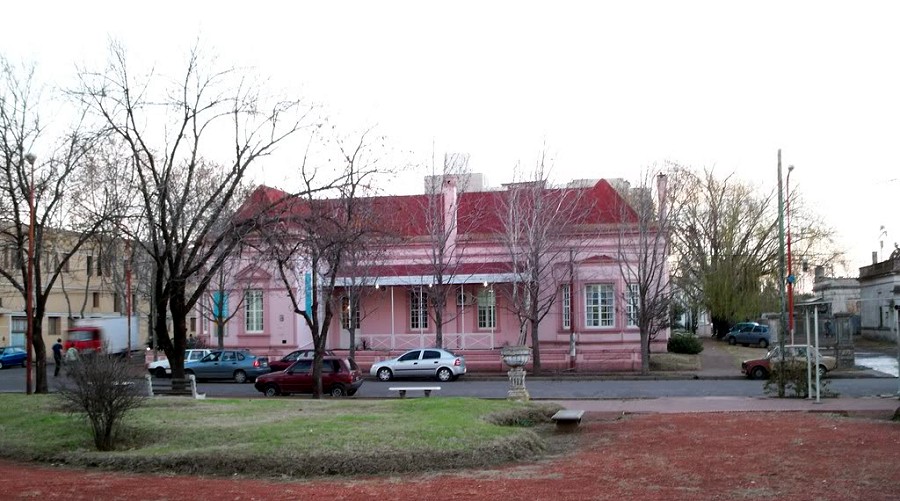
14 October 2005 – Universidad del Noroeste Junin/Buenos Aires
MACRO – Museum of Contemporary Art Rosario
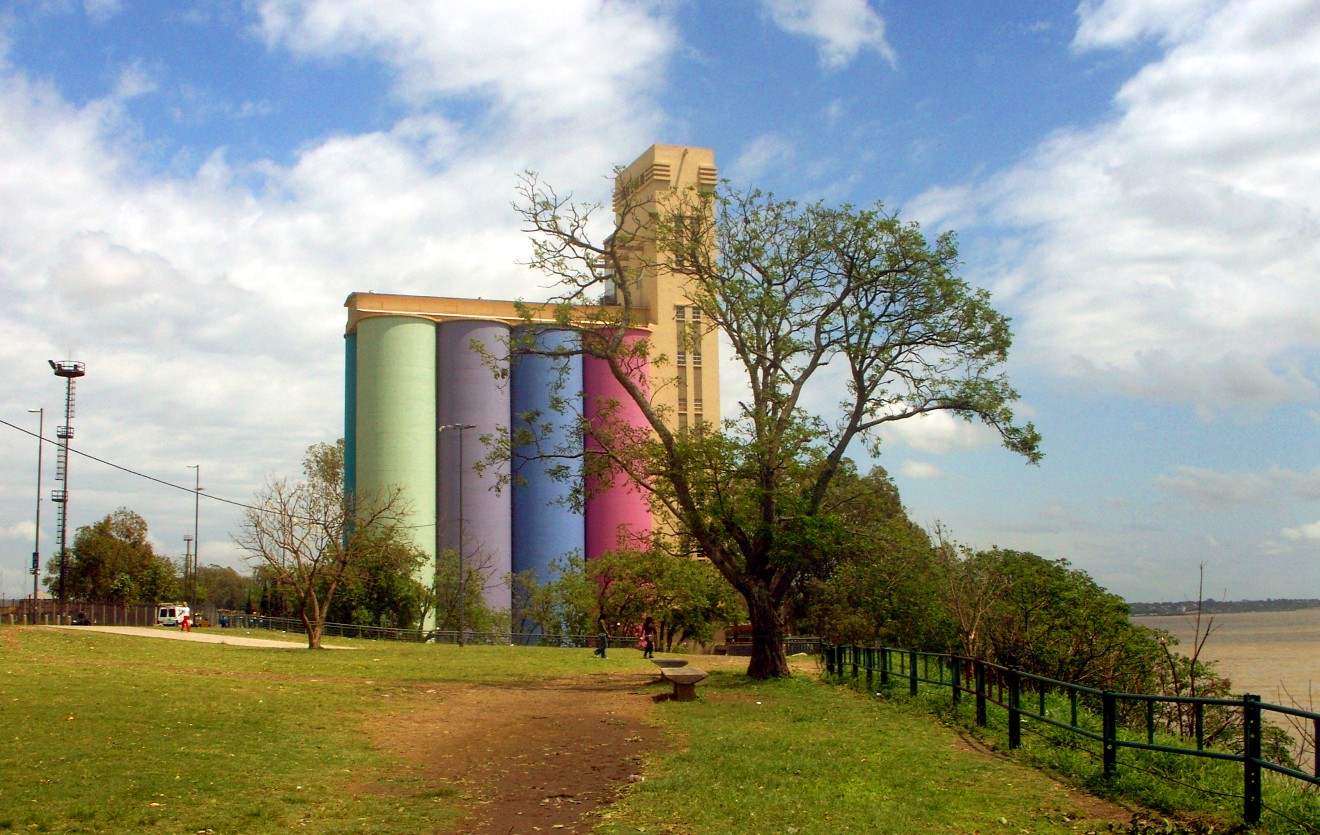
18 October 2005 – MACRO – Rosario Contemporary Art Museum
Universidad de Arte Rosario

19 October 2005 – Universidad de Arte Rosario
MAC – Santa Fe Contemporary Art Museum

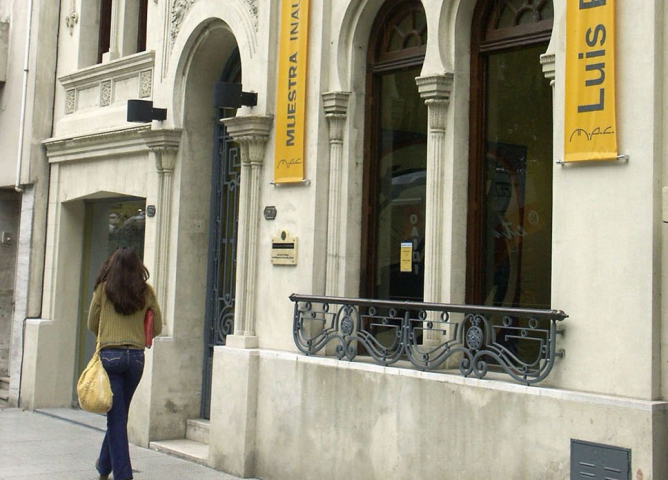
21 October 2005 – MAC – Santa Fe Contemporary Art Museum
As a standing alone interactive multimedia project
W:MoRiA was presented 2012 & 2013 @
A Virtual Memorial Riga 2012
http://riga.a-virtual-memorial.org
A Virtual Memorial Vilnius 2013
http://vilnius2013.a-virtual-memorial.org
As a standing alone interactive multimedia project
W:MoRiA was presented 2012 & 2013 @
2005/2006 @
*VIII SALON Y COLOQUIO INTERNACIONAL DE ARTE DIGITAL Havanna/Cuba – 17/06-17/07 2006
*FILE – Rio de Janeiro/Brazil 20/03-20/04 2006
*FILE – Electronic Language Festival Sao Paulo/Brazil 2005
*Museo de Arte Contemporáneo del ZULIA, MACZUL – Salón de Arte Digital – 2005
*Version’05 Festival Chicago/USA – 2005
*ZKM Karlsruhe/G – MAKING THINGS PUBLIC —>Fair Assembly 2005
As an integral part of
[R][R][F]200x–>XP global networking project
http://rrf200x.newmediafest.org/
W:MoRiA was presented 2005/2006
01. Festival Arte Digital Rosario/Argenina – 16-18 November 2006
02. Play IV VideoFestival Buenos Aires/Argentina 24-27 August 2006
03. PI 5 Intermedia Festival Szczecin/Poland – 20-22 October 2006
04. VIII SALON Y COLOQUIO INTERNACIONAL DE ARTE DIGITAL Havanna/Cuba – 17/06-17/07 2006
05. MAF’06 -New Media Art Festival Bangkok/Th 02/05-04/05 2006
06. FILE – Electronic Language Festival Rio de Janeiro/Brazil 20/03-20/04
07. CeC & CaC – India International Center New Dehli/India 27/01-29/01
08. “Global Groove” – The Art Gallery of Knoxville/USA – 01/01-25/01
09. Biennale of Video and New Media- Santiago/Chile – 18/11-27/11
10. State University – Rio de Janeiro/Brazil – 7/11
11. Univercidade – IAV (Institute of Visual Arts)- Rio de Janeiro/Brazil 7/11
12. Select Media 4 Festival- Chicago/USA – 20 October – 13 November
13. National Academy of Fine Arts Montevideo/Ur – 28/10 -/lect/pres
14. Finis Terrae University- Santiago/Chile – 25/10
15. MAC – Museum of Contemporary Art- Santa Fe/Argentina 21/10
16. National University/Art Department- Rosario/Argentina – 18/10
17. MACRO – Museum of Contemporary Art- Rosario/Argentina 17/10
18. Recoleta Cultural Centre- Buenos Aires/Argentina – 11/10
19. National Library Buenos Aires/Ar 12/10
20. Interferencias – University of Noroeste/Ar 14/10
21. PI five Video Festival Szczecin/Poland 9/10 -13/11
22. “Groundworks” Regina Gouger Miller Gallery at Carnegie Mellon – University Pittsburg/USA 14/10 – 11/10
23. Prog::ME – Electronic Art Festival Rio de Janeiro/Br 17/07-28/08
24. V SALON INTERNACIONAL DE ARTE DIGITAL Maracaibo/Venezuela 20/03-02/07
25. EAST’05 – Making Things Better – Norwich/UK 02/07- 20/08
26. MAF’05 June edition – New Media Art Festival Bangkok/Thailand
27. Hic et Nunc San Vito a/Tagliamento/Italy – Selection’03 11/07-17/07
28. Israeli Digital ArtLab Holon/Israel 16/04- 16/07
29. Version’05 Festival Chicago/USA 22/04- 01/05
30. Images Festival Toronto/Canada – 7/04 – 13/04
31. ZKM Karlsruhe/G – Making Things Public – 20/03- 08/03
32. Camera Obscura Academy Tel-Aviv/Israel – lecture – 02/03
33. MAF05 – New Media Art Festival Bangkok/Thailand – 25/02-29/02
34. Musrara Media Art Academy Jerusalem/Israel – lect/pres 22/02
35. Bethlehem International Center – lect/pres – 19/02
36. Bethlehem University – lect/pres- 17/02
37. CAVE Gallery at ICB Bethlehem/Palestine- solo show 17/
38. University of Bremen/Germany – December 2004
39. 404 New Media Art Festival Rosario/Argentina (7-15 Dec) 2004
40. FILE – Electronic Language Festival Sao Paulo/Brazil (23 Nov-12Dec) 2004
41. 1st International Exhibition of Digital Art – Museum of Contemporary Art Santa Fe/Argentina (04/11- 04/12) 2004
42. 24h of Nuremberg/Germany – International Shortfilm Festival 15/16 October 2004
43. Biennale of Electronic Art Perth (Australia) (1/09 – 7/11) 2004
44. West Coast Numusic & Electronic Arts Festival Stavanger/Norway 17/08-22/08 2004
45. public_space_festival Yerewan/Armenia 23/07 – 03/08 2004
46. International Festival of New Film and New Media Split/Croatia (26/06-02/07) 2004
47. VI SALON Y COLOQUIO INTERNACIONAL DE ARTE DIGITAL – Havanna(Cuba) 21/06-24/06 2004
48. BASICS Festival Salzburg/Austria – 08/05-16/05 2004
49. Electronic Art Meeting – PEAM 2004 – Pescara (Italy) 19/05-23/05 2004
50. Version’04 Festival – Invisible Networks – Chicago/USA – 16/04-01/05 2004
51. Now Music Streaming Festival Berlin (Germany)- – 7/04 2004
51. New Media Art Festival Bangkok (Thailand) (20/03-28/03) 2004
52. Bergen Electronic Arts Centre Bergen/Norway (05/03- 28/03) 2004
53. National Museum of Contemporary Art Bucaresti/Romania (05/03-30/04) 2004
Credits
“Family Portrait” is an Internet based project created, designed and realized by Agricola de Cologne.
copyright © 2001-2005.
All included content related images, texts and art works
copyright © by the owners or authors, if not otherwise noted.
Most thanks to Raquel, Salomón, Alicia and Ruth, but also all other Partnoy family members involved.
Many thanks to MOSAICA, Toronto/Canada, only the Award given to “Family Portrait” made this third and final version possible.